
Picture this: it’s 8 pm on a Friday. You open an app, check a café’s rating — 4.2 stars, 280 reviews — and still have no idea whether to walk in. Is it packed? Is the vibe off? Is the coffee actually good tonight or is the person making it new?
The rating tells you none of this. It never could. It was written by people who left.
That’s the gap Opar was built to close — as a location-based social app that replaces guesswork with real-time signals from people who are physically there right now.
What’s actually broken about how we discover places
The problem isn’t that existing platforms are bad. It’s that they were designed for a different job. Reviews, ratings, and curated posts answer the question: was this place worth it?
Opar — a venue discovery app built for the present moment — answers a different question entirely: is this place worth it right now?
Those two questions sound similar. They are completely different products.
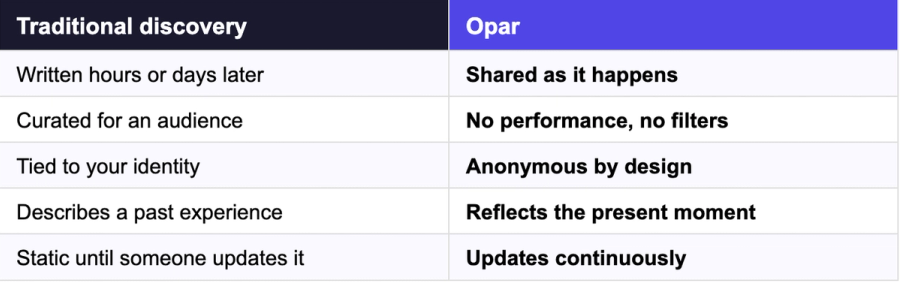
Why real-time changes everything
When you remove the delay between experience and sharing, something interesting happens. People stop composing and start reacting. A short, honest signal — unusually quiet tonight, queue moved fast, the terrace is open — travels the moment it’s felt.
These aren’t reviews. They don’t need to be. They’re lightweight enough that sharing feels like a reflex, not a task. And collectively, they build something no single review ever could: a live picture of what a place is like at any given hour.
This is what real-time place discovery actually looks like — not a leaderboard of yesterday’s opinions, but a living signal of right now.
“Every signal on Opar was posted by someone who was physically there — not summarising a memory, but reacting to a moment.”
Why anonymity is a feature, not a compromise
On most platforms, your posts are attached to your name, your photo, your follower count. That visibility is the point — but it also changes what people say. When you know you’re being seen, you curate. You smooth things out. You write for the reader, not from the experience.
Opar strips that layer out. No profile, no followers, no performance. Just what you actually noticed — and that turns out to be far more useful to the person deciding whether to walk through the door.
As an anonymous social app, Opar makes sharing feel zero-stakes — which means people actually do it, honestly and in the moment.

What this means for the places on Opar
For a café, a bar, a bookshop, a park — Opar means your best moments finally have a way to travel. As the go-to app for finding places near you tonight, Opar sends a live signal — not a review someone might write tomorrow — to the person two streets away who’s trying to decide.
A place that’s dead on the rating sites but buzzing on a Wednesday afternoon — Opar surfaces that. A new spot that hasn’t accumulated reviews yet — Opar starts building its signal the moment the first person walks in.
Visibility, on this hyperlocal social discovery platform, is earned in real time. Not banked over months.
We’re just getting started
Opar is live now. Every reaction posted, every signal shared, adds to a layer of real-time context that makes the next person’s decision a little sharper, a little more honest. Whether you’re looking to connect with people around you or simply find what’s worth your time tonight — Opar is where that answer lives.
The city has always had this pulse. We’re making it visible for the first time.