
You’ve been to a great place alone. You’ve sat in a buzzing room and felt invisible. Opar was built for the space between those two feelings — where a venue becomes something more than four walls.
Think about the last time you walked into a place — a café, a rooftop bar, a bookshop, a weekend market — and the atmosphere just hit you. The music was right. The crowd had an energy. You didn’t want to just consume the place. You wanted to be part of it.
Now think about how many other people in that room felt exactly the same. And how none of you ever said a word to each other.
That’s the gap Opar was built to close. Not with awkward introductions or forced ice-breakers — but by making the place itself the conversation starter.
So, what exactly is Opar?
Opar is a social discovery platform. But that phrase doesn’t quite capture what it does, so let’s be more specific.
Opar sits at the intersection of two things that have never been combined properly: discovering great places around you, and connecting with the people who are already in them.
It’s not a review app. It’s not a dating app. It’s not a social network where you build a profile and curate your life. It’s a real-time layer on top of the physical world — one that lets you see what’s happening nearby, feel the pulse of a venue, and start a conversation if the moment calls for it.
“Opar doesn’t ask you to perform. It asks you to show up — and see who else did.”
The problem with how we discover places today
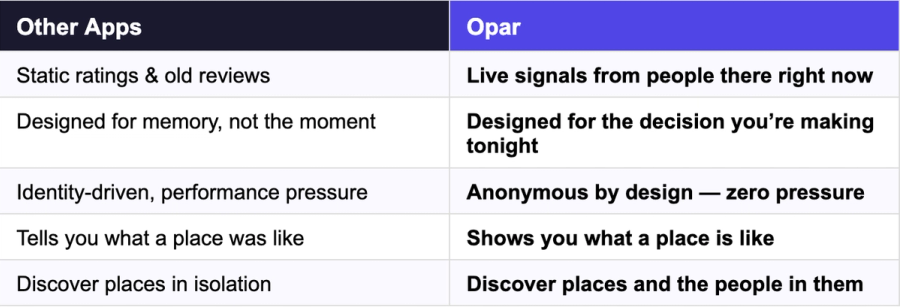
Open any popular app to find somewhere to go tonight. You’ll get a list. Ratings. Photos that were taken months ago by someone with a better phone than you. A review that begins with “I came here for my friend’s birthday…”
What you won’t get is what the place is like right now. Whether it’s dead or alive. Whether there’s a crowd that feels like your kind of crowd. Whether it’s worth the walk.
Traditional discovery was built to answer: “was this place good?” Opar was built to answer something far more urgent:
Is this place worth it right now — and who’s there?
Why venues are the missing piece of social
Here’s a question worth sitting with: when was the last time you made a new friend or had a genuinely interesting conversation with a stranger — not online, but in a real place?
For most people, the honest answer is: it’s been a while. And it’s not because we’ve stopped going out. It’s because going out and being socially connected have drifted apart. We sit in the same room and scroll separate feeds.
Venues have always been where social life actually happens — where cities have their pulse. Opar believes they can be that again. Not by gamifying social interaction or pushing you to connect, but by giving a place the ability to bring people together naturally.
When a venue has a live signal — when people inside it are sharing what’s happening in real time, anonymously and effortlessly — the place becomes magnetic. It creates a reason to walk in. A reason to look up from your phone. A reason to start talking.
“Every great venue has an energy. Opar makes that energy visible before you even walk through the door.”
Anonymous by design — and that’s the whole point
Most social apps are identity machines. Your profile is your brand. Your posts are auditions. The pressure to look interesting, well-travelled, social enough — it’s exhausting, and it changes what people say and do online.
Opar removes all of that.
No profile to build. No followers to grow. No photo to approve before posting. When you share something on Opar — a reaction to the vibe, a heads-up about a spot, a thought from wherever you’re sitting — it travels without your name attached to it.
What this does is remove the performance layer entirely. People stop writing for an audience and start reacting to the moment. And those real, unfiltered reactions turn out to be exactly what someone two streets away needs to decide where to go.
Anonymity on Opar isn’t a privacy feature. It’s a design philosophy. It makes connection feel low-stakes enough that it actually happens.
Discovery and connection, finally in the same place
Here’s what makes Opar genuinely different from anything else out there:
- You open the app and see what’s alive near you — not a ranked list, but a real-time map of places with active energy.
- You can read live signals from people inside those places — what the vibe is, whether it’s worth the trip, what’s happening right now.
- If you’re already at a venue, you can start an anonymous conversation with others there — no awkward approach required.
- The interaction feels natural because it’s tied to something you already share: you’re both in the same place, at the same time, choosing to be there.
No swiping. No matching. No algorithm deciding who you should meet. Just the natural friction of shared space — finally made digital.
What this means for the places you love
If you run a venue, or even just love one, here’s what Opar changes:
Right now, a great Tuesday night at your favourite bar reaches nobody. The energy in the room doesn’t travel. The person two blocks away who would have loved it never knows it happened.
Opar changes that equation. Every person inside a venue becomes a live signal for everyone nearby. Not a review. Not an ad. A real moment, shared in real time, reaching someone who’s deciding right now.
The best venues have always built their reputation word of mouth. Opar is what word of mouth looks like when it moves at the speed of now.
“Visibility on Opar is earned in the moment — not banked over months of accumulating reviews.”
The vision: a city that feels alive again
There’s something that gets lost in a world of delivery apps, remote work, and curated feeds: the feeling that the city around you is actually alive. That interesting things are happening nearby. That the people you’d love to talk to are somewhere within walking distance.
That feeling hasn’t gone away. The infrastructure to surface it just hasn’t existed.
Opar is building that infrastructure. A layer on top of the physical world that makes the social energy of real places visible, accessible, and actionable — in real time.
Not a replacement for real life. A way to make real life easier to find.